Point Clouds and Field Recordings of Urban Nature
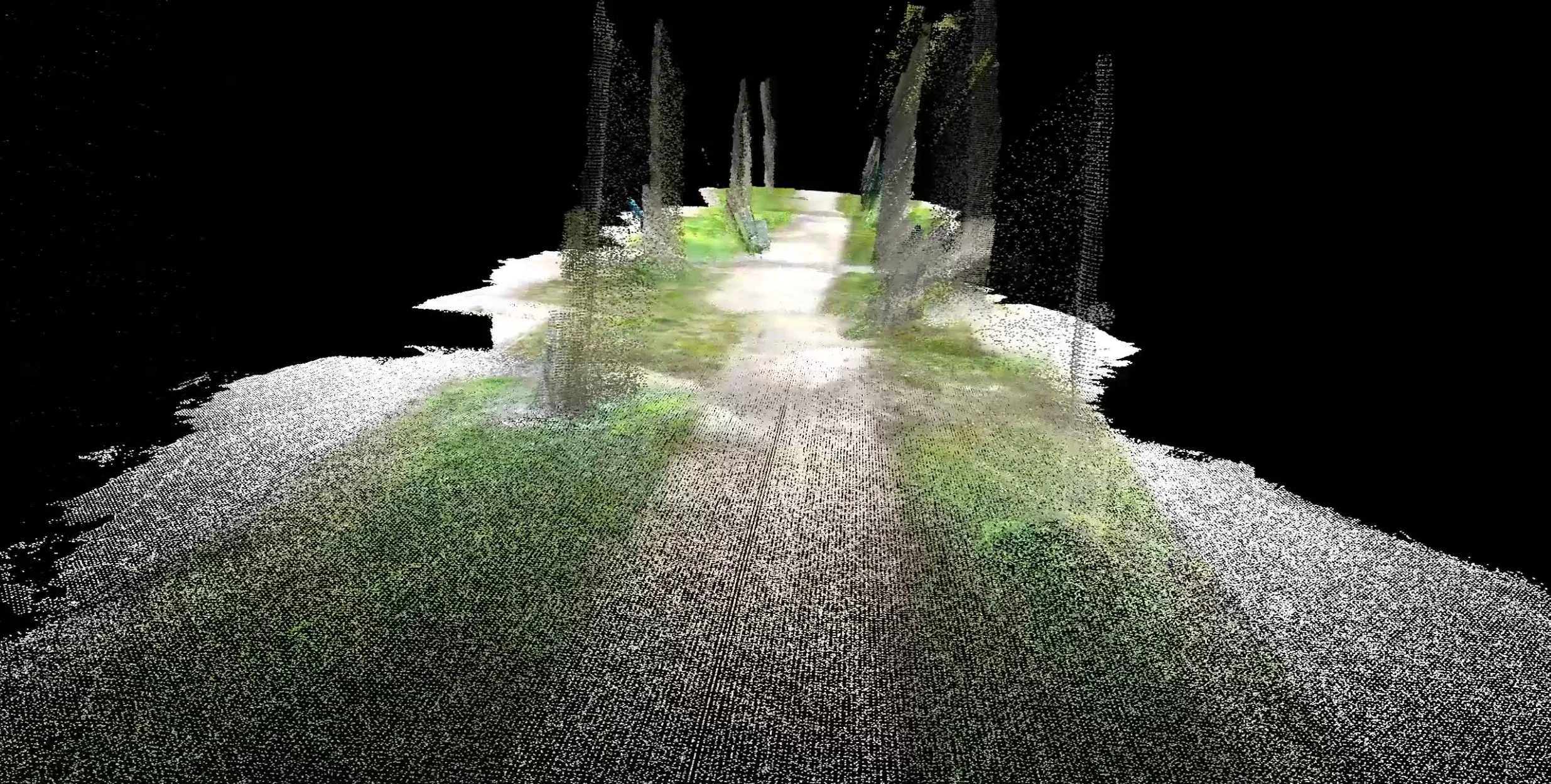
Nature Noise 030
Point Clouds and Field Recordings of Urban Nature | Bio Art
In the relentless stream of urban life, attention is a fragile resource. Nature Noise 030 is a research-based audiovisual installation that explores the urban nature often overlooked: the birdsong weaving through traffic, the wind shifting between buildings, and the grass pushing through pavement.
Rather than treating nature as something external to the city, this project investigates how natural and human-made elements coexist within the same ecosystem. By utilising field recordings and LiDAR-based point cloud visualisation of Utrecht’s Maliebaan, the work seeks to make the familiar audible and visible once more.
"In constructing a situation where listening and looking regain their meaning."
Methodology: Data as Space
The project operates in the space between recording and abstraction. By processing LiDAR data through TouchDesigner, the Maliebaan is transformed from a recognisable street into an abstract field of coordinates.
Audio (Field Recording): Captured using a Zoom H5, the soundscape embraces the totality of the environment, including "human" noise, to foster a sense of "Deep Listening." The audio structure is semi-algorithmic and non-linear, allowing textures to shift and breathe independently of the visual path.
Visuals (Point Clouds): Using LiDAR scanning + TouchDesigner, the site is rendered not as a photograph, but as discrete data points. Through instanced geometry and slow-form camera movement, the visuals evolve from recognisable architecture to abstract data structures, stripping away the "spectacle" to focus on the structure of the space itself.
The Logic of Reduction
A recurring theme throughout the development was the tension between complexity and simplicity. While the urge to add "more" is often present in digital art, this project found its strength in reduction. By intentionally decoupling the audio and visuals, making them non-audio-reactive, the installation mirrors the natural world: sounds and sights exist side-by-side, sharing an origin but evolving independently. This forces the viewer to become an active participant, drawing their own connections between the field and the frequency.
Point Cloud R&D
These videos document my initial research into point cloud processing within TouchDesigner. My goal was to move beyond static 3D models, exploring how to transform raw coordinate data into reactive, breathing digital environments. These experiments served as the technical foundation for my later spatial and site-specific installation work.
System Reactivity: Exploring how external inputs (parameters and LFOs) can manipulate instanced geometry in real-time.
Interactive Mapping: Testing the boundaries of depth-map data and point cloud workflows to understand how "data as space" behaves within a digital environment.
LiDAR & Data Abstraction: Utilising LiDAR scanning, I translated the physical geometry of the Maliebaan into digital point clouds. Through custom TouchDesigner workflows, these coordinates were transformed from static architectural data into dynamic, reactive systems.
Acoustic Ecology: The project utilises localised field recordings captured at varying times of day. By decoupling the audio from the visuals—allowing both to exist independently yet within the same environment—the work fosters a state of "Deep Listening."
Software: TouchDesigner, Ableton Live
Methodology: LiDAR point cloud processing, instanced geometry, and non-linear sound synthesis.
Location: Maliebaan, Utrecht, 2026